Media Library Manager

Folders and tags that persist outside the editor, semantic search that finds images by what they show, color and orientation filters, smart folders, and a full set of housekeeping tools.
The Media Library Manager dialog in WunderPaint
Library & Assets

Real folders, real tags, and a search that finds pictures by what is in them.

This is the one I would point at first if somebody asked what the plugin actually changes about running a WordPress site, and it is the one people are most surprised to find in the free version.

Every WordPress media library over about two years old is the same room: a few thousand files, a third of them unused, most of them larger than they need to be, all named IMG_4471 and screenshot-2. The library is technically searchable and practically not, because filenames carry no meaning and there are no folders.

The Media Library Manager is a full manager for that library, and it is worth going through what it actually does, because there is a lot in there.

Folders and tags, which are not the same thing

Folders answer where does this belong, and a file lives in exactly one of them. Tags answer what is this about, and a picture can carry as many as you like. Most libraries want both: a small number of folders reflecting how work arrives, and generous tags reflecting how work is looked for.

Both are stored as ordinary WordPress taxonomies. That detail matters more than it sounds: your organization is not locked inside a plugin’s own tables. It exists in WordPress, it survives, and other things can see it.

Drag images between folders, multi-select with Shift and Ctrl the way you would expect, and then move, tag, set as featured image or delete in bulk.

Search that actually finds things

Here is the part people refuse to believe, and it is really a small neural model running in your browser. Type a phrase describing what you are looking for, and it finds images by what they show rather than by what they are called.

Search for people smiling outdoors and you get people smiling outdoors, including the file called DSC_0442.jpg that nobody has ever been able to find again. No filename, no alt text, no manual tagging required.

It runs locally, which is the part I care about. There is no API key, no per-image cost, and no upload of your customers’ photographs to somebody else’s server. On a big library the first pass takes a moment while it reads everything, and after that it is instant.

And the search combines with the filters rather than replacing them, so you can narrow a semantic result by color, file type, orientation, size, author and date, then sort what remains.

Filtering by color

The row of color dots above the grid is the filter I did not expect to use and now use constantly. Click one and you get every image whose dominant color sits in that range.

It sounds like a novelty until you are building a page and need a photograph that will not fight the blue in your design. Then it is the fastest route to a shortlist there is.

Smart folders

Three of them fill themselves. Missing alt text collects everything with an empty alt attribute, which turns a vague accessibility worry into a finite list you can work down. Unused collects files nothing links to. Reclaim space collects the oversized originals that are inflating your backups.

And any search you build can be saved as your own smart folder, so a filter you keep rebuilding becomes a permanent entry in the sidebar.

The housekeeping tools

At the bottom of the sidebar sits a set of operations that would otherwise be four separate plugins.

Suggest folders clusters similar images so a flat library can be organized in one pass rather than one file at a time. Find duplicates groups near-identical images for review with a keep-or-trash choice per image, which is the safe way to do it, because automatic duplicate deletion is how people lose the wrong copy. Rename by pattern fixes the IMG_4471 problem across the whole library. Regenerate thumbnails, Find broken files and Add Watermark round it out, Optimize images opens the Image Processor from WunderPaint Pro, and Generate Metadata fills in titles, alt text and descriptions in bulk.

Uploading is smarter here too

Files dropped into the manager are checked against your library for near-duplicates before they are imported, which stops the same photograph arriving for the fourth time. They land straight in the folder you are looking at. And on the way in they can be optimized, converted to WebP, downscaled and described.

That last part is the habit that keeps a library clean rather than cleaning it up later: name it, describe it and size it at the moment it arrives, while you still remember what it is.

PDFs upload too and appear under the Documents type, which is useful more often than it sounds.

The list view

The grid is right for finding pictures. The list view is right for auditing them, because it shows the metadata columns: dimensions, file size, type, date. When you are hunting for the reason your uploads folder is eight gigabytes, this is the view you want.


Play Video

Where to find it

Assets, then Manage Media Library

What it replaces

A media folders plugin, a duplicate finder and a lot of scrolling

What you get

  • Real folders and tags, stored as WordPress taxonomies
  • Semantic search by image content, running locally
  • Filters for color, file type, orientation, size, author and date
  • Smart folders for missing alt text, unused files and reclaimable space
  • Duplicate finder with a keep-or-trash review per image
  • Bulk move, tag, set as featured image, delete and watermark
  • Near-duplicate check, optimization and description on upload
  • Grid and list views, PDF support

Requirements

Part of the free plugin. The semantic search runs on a local model, in your browser, with no key and no upload. The Optimize images button opens the Image Processor, which is part of Pro.

Frequently asked questions

No. The model runs in your browser. Nothing is uploaded, there is no API key, and there is no per-image cost. On a large library the first pass takes a moment while it reads everything, then it is instant.
No, and this is deliberate. Folders and tags are ordinary WordPress taxonomies, so they are stored in your database like categories are. Nothing is trapped in a proprietary structure.
Treat it as a shortlist, not an instruction. Detecting whether an image is genuinely unused is hard, because references hide in page builder data, custom fields and theme options. Take a backup, review the list, and delete in batches.
That is exactly what it is for. The order that works: back up, shrink the oversized originals, generate the missing metadata, suggest folders, then look at duplicates and unused files last, because those are the only steps that delete anything.

Features

Semantic search, running locally

Find images by what they show, not by what they are called. A small model in your browser, no key, no cost per image, no upload.

Features

Folders and tags as real taxonomies

Your organization lives in WordPress rather than inside a plugin's own tables, so it survives and other tools can see it.

Features

Smart folders that fill themselves

Missing alt text, unused files and oversized originals collected automatically, plus any search of your own saved as a folder.

Features

The housekeeping in one place

Duplicate finding with a review step, folder suggestions, bulk rename, thumbnail regeneration, optimization, watermarking and metadata generation.

Experience Media Library Manager in WunderPaint

Real folders, real tags, and a search that finds pictures by what is in them.

Brush & Paint Styles

Paint with six styles that mix pigment instead of blending it, pick from thirty-seven tips shown as real strokes, draw a tip of your own out of shapes, and let the color travel along the stroke.

Collage & Photo Grid

Arrange media library photos as a grid, mosaic, polaroid, filmstrip or contact sheet, tune gaps, corners and frames on a live preview, and insert it all as an editable layer group.

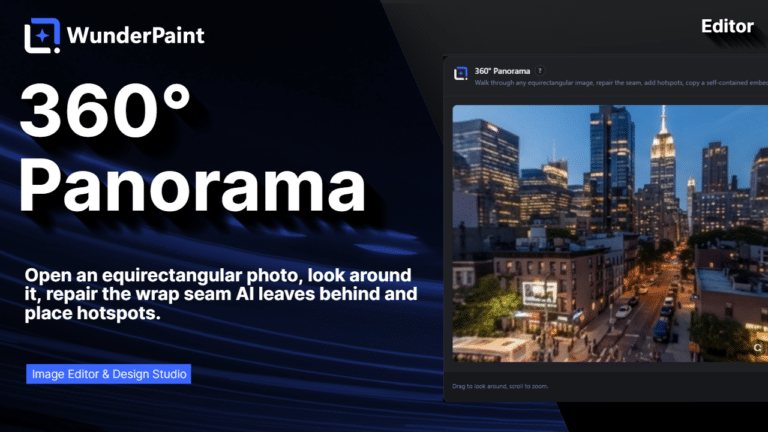
360° Panorama

Describe a place and the tool builds the full sphere around you, or let it rebuild a photo you already have as the whole scene around the camera. What comes out is somewhere visitors can look around, hotspots and all, in an embed that carries its own viewer.

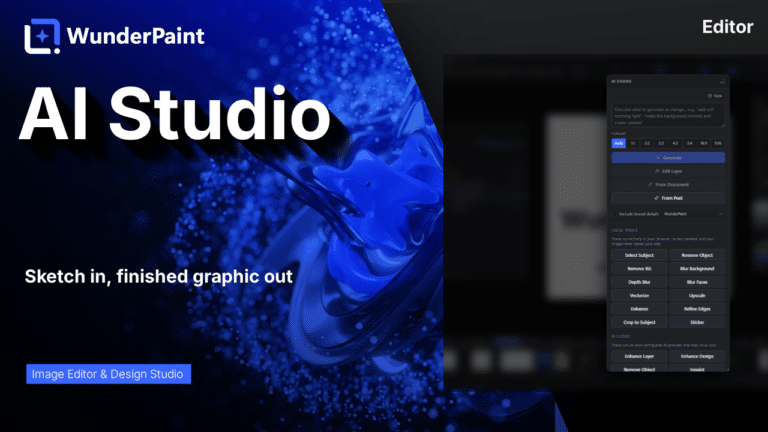
AI Studio

Generate, edit, retouch and clean up images from a prompt or a single click, all in one panel. Many tools run locally with no key; prompt generation uses your own Gemini or OpenAI.

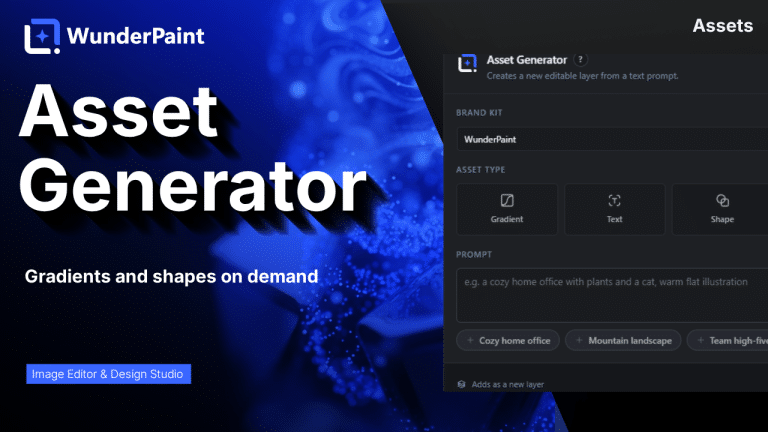
Asset Generator

Gradients, text treatments, shapes and illustrations generated from a prompt, in your brand colors, arriving as editable layers.

Stock Images

Search Pexels, Pixabay and Unsplash without leaving the editor, and insert what you find as a layer rather than a download.

Asset Library

Ready-made designs across social, marketing and seasonal categories, opening as layered documents in a new tab so your current work stays untouched.

Brand Kits

Colors, typefaces, a logo, a watermark and a company profile in one place, feeding every picker, template and generator on the site.

Media Library Manager

Folders and tags that persist outside the editor, semantic search that finds images by what they show, color and orientation filters, smart folders, and a full set of housekeeping tools.

Check Contrast

Audits the text layers in your document, reports the contrast ratio for each and tells you which ones are hard to read.

QR Code Generator

Links, text, email, phone, SMS, Wi-Fi access and contact cards, styled with your colors, module shapes and a center logo.

Chart & Table

Turn data into chart or table layers that stay editable, styled with your own typeface and colors rather than a spreadsheet default.

Content Generator

Article, SEO title, meta description, slug, tags, FAQ and sources, plus body images, a featured image and a social crop, all as a draft.

Generate from CSV

Type placeholders into your text layers, pick a spreadsheet whose columns carry the same names, and every row renders the design once.