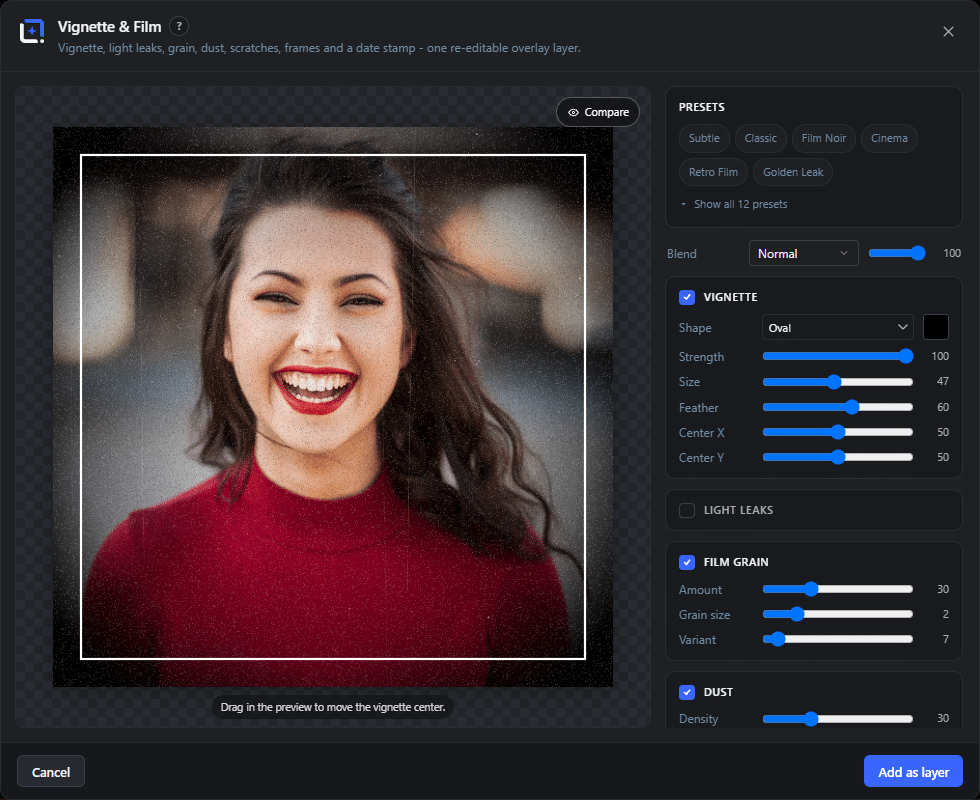
A vignette does something quietly useful: it stops the eye wandering out of the picture. Photographers spent decades trying to eliminate it as a lens defect and now add it back deliberately, which tells you how well it works.
This covers the soft ones and the hard ones. Oval and circular vignettes for holding attention, edge and corner darkening for a gentler version, letterbox bars and pillars for changing the apparent format, and then the physical frames: instant photo, solid border, thin and double lines, filmstrip, slide mount, rounded matte and a painted edge.
Every one of them arrives as an overlay layer with its own controls, so it can be softened, strengthened, recolored or switched off at any point. That matters, because a vignette that is visible as a vignette is almost always too strong, and the only way to judge it is to toggle it.
The framed ones are worth knowing about for a different reason: they turn a plain photograph into an object. A slide mount or an instant photo border says something about the picture before anybody looks at it.